
EUCOPE Resources / News - November 17, 2025
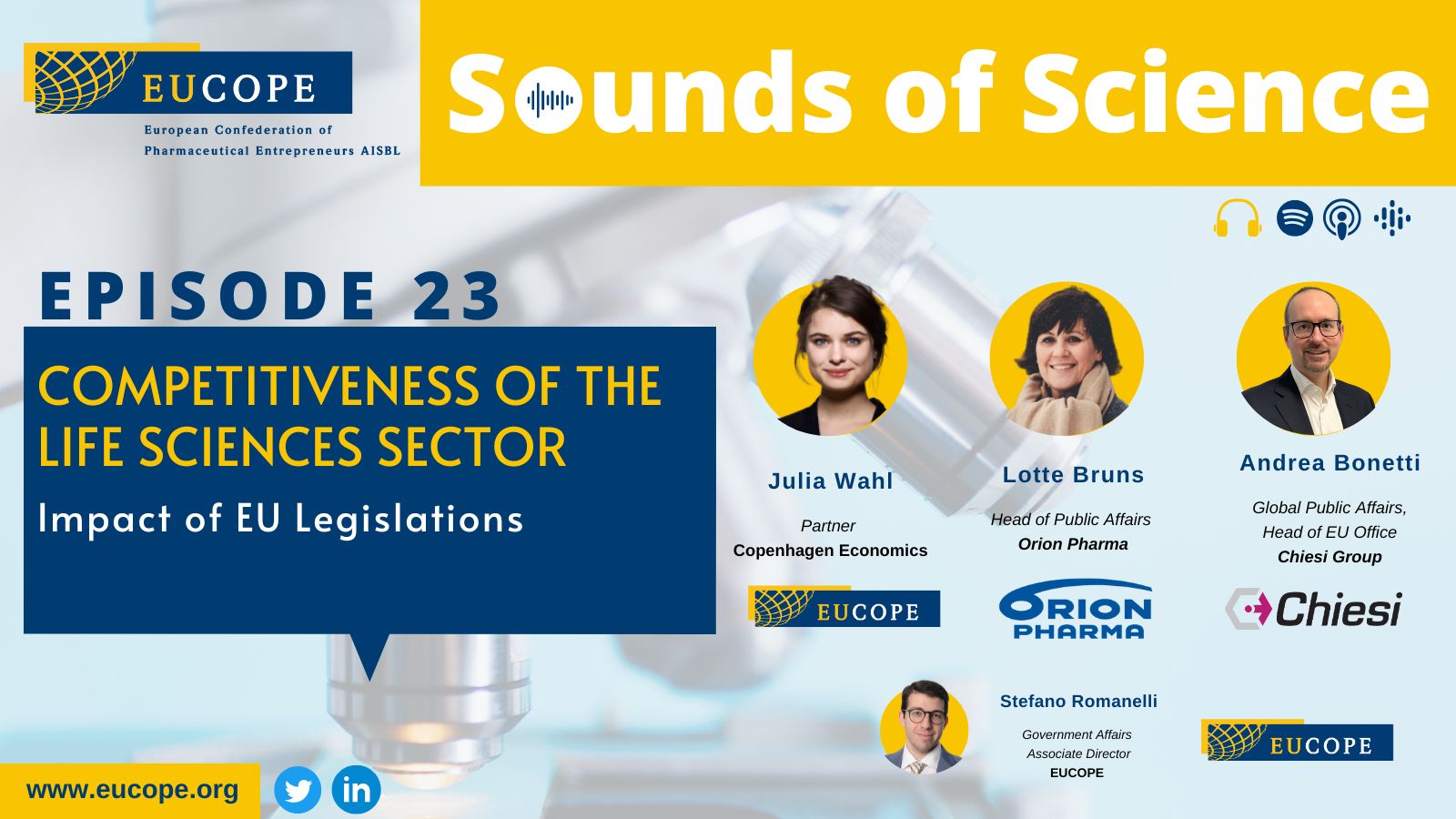
SOUNDS OF SCIENCE PODCAST EPISODE #23 – Impact of EU legislations on the competitiveness of the life sciences sector
Sounds of Science – Episode 23
Competitiveness in Life Sciences: Report on Impact of EU Legislations
In this episode of EUCOPE Sounds of Science, we launch the report titled Competitiveness of the EU Life Sciences Sector – Analysis of the impact of current and future EU legislations on the competitiveness of the EU life sciences sector. This report, that EUCOPE commissioned to Copenhagen Economics, dives into a fundamental topic: the competitiveness of the EU Life Sciences Sector. The report assesses the impact of a number of key EU healthcare legislations on the industry’s capacity to innovate, cost of compliance, international competitiveness and market access.
In this new episode, Stefano Romanelli, Government Affairs Associate Director at EUCOPE, is joined by:
- Julia Wahl – Partner – Copenhagen Economics
- Lotte Bruns – Head of Public Affairs – Orion Pharma
- Andrea Bonetti – Global Public Affairs, Head of EU Office – Chiesi
Together, they discuss the Report and share their recommendations for the EU’s response to building a competitive ecosystem.
Key topics include:
- The EU has not yet sufficiently seized the opportunity to improve capacity to innovative
- Cost of compliance and complexity have substantially increased
- The EU may not close the widening international competitiveness gap: there is urgent reform to counter to counter the decline in R&D and clinical trials in the EU
- Speed of market access will likely not improve, due to existing gaps at EU and national levels
- There are still opportunities to increase EU competitiveness and attractiveness for innovative companies, such as the Biotech Act
Episode Highlights
Julia Wahl:
“Key legislative bottlenecks holding back innovation in Europe: the main economic incentives for innovation in the EU regulatory framework […] have been weakened. [Modulation] criteria are in part quite narrowly defined and it’s also quite difficult to predict as a company, as an investor whether certain products will ultimately meet those conditions and benefit. Instead of stepping up on incentives to make sure Europe can compete in the most high-value cutting edge segments we’ve taken an approach to reduce baselines and add a quite complex modulation system on top of that. Moreover, we see continued fragmentation and high regulatory burdens with, for instance, the clinical trial regulation and the HTA regulation. Our analysis shows that both legislations fall short of their potential because instead of harmonizing they are consolidating the diverse requirements of 27 Member States into a single, more complex, more burdensome process at EU level. The difficulty is the cumulative impact of all these individual legislations.”
Lotte Bruns:
“Legislation plays part in three things. It’s about attracting capital – monetary or human capital – into local markets, acceleration, and access, the reward of innovation. Europe has had challenges – only half of the new molecules get to the patients. Pharma business is a global business. We’re looking at where in the world it is interesting to invest. […] We look at the whole picture, the entire value chain needs to be attractive. Not one single legislation does it – it’s the whole package that we are evaluating. There is still much to do in order to get the whole 27 countries to work as one. If we regulate, let’s make better regulation.”
Andrea Bonetti:
“As the EUCOPE report notes, many EU health initiatives have yet to deliver, particularly on harmonisation. Europe’s life-sciences sector has vast potential; we should seize this opportunity now. Maintaining the status quo is no longer sufficient.”
Read the full Report.
Listen to the full episode: